Somewhere in the last few years, skincare writing settled on a set of conversion numbers. One percent retinol is supposedly a match for 0.05% tretinoin. Retinaldehyde is about ten times stronger than retinol. Tretinoin is twenty times stronger than retinol. The figures turn up on clinic sites, brand pages, telehealth blogs and, increasingly, in Amazon product titles, stated the way you would state a melting point.
So we went looking for where the retinol to tretinoin equivalent came from. A number that specific ought to have a measurement behind it, and the measurement tells you how far the number can honestly be stretched. What we found was one cell-culture assay from 1994, a 1990 enzyme-rate table, a great deal of copying, and one good clinical trial that almost nobody cites and that contradicts the figure most people quote.
Table of contents
- What the retinol conversion charts say
- The trail runs to one 1994 paper
- Where “11x faster” comes from
- The one retinol to tretinoin equivalent that holds up
- The chemistry is real, the arithmetic is not
- What about retinaldehyde?
- The problem nobody mentions
- What to do instead
- Products that disclose what is in them
- Frequently asked questions
- References
We do not run a laboratory. What we did was follow citations: take each number, find the page that states it, find what that page cites, and keep going until we reached a measurement or the trail stopped. Every source is listed at the bottom so you can walk the same path.
What the retinol conversion charts say
We looked at eleven pages that state a numeric retinoid equivalence: dermatology clinics, brand education pages, telehealth providers and retail listings. The pattern is consistent enough to be worth a table.
| What the page claims | Does it cite a source? |
|---|---|
| “Tretinoin is up to 20 times more potent than retinol” | No source of any kind |
| “Tretinoin is estimated to be about 20 times more potent than retinol” | Links to another blog, which cites nothing |
| “Tretinoin is believed to be 20 times more potent than retinol” | Two citations. One is a real review. The other is a StatPearls page that does not contain the claim |
| “Approximately 10 times greater vitamin A activity than retinol” | “Research indicates”, with no name, link or footnote |
| “Delivers results up to 11x faster than standard retinol” | Yes, a 1990 biochemistry paper. The paper does not contain the number |
| “Tretinoin 0.1% is 20 times more potent than the highest strength retinol and 10 times stronger than the highest strength retinal” | One link, to general background, not to any number |
That caption is the finding, really. One page in eleven. The rest cite nothing, cite another blog, or list references at the foot of the article that are not attached to the number in the text.
The trail runs to one 1994 paper
The one page that does cite something points at Mukherjee and colleagues, writing in Clinical Interventions in Aging in 2006. It is a real review in a real journal, it is open access, and it does contain the sentence everyone is echoing: retinol “is 20 times less potent than tretinoin and it requires further conversion to retinoic acid (in vivo) to demonstrate its action”.
A review summarizes other people’s measurements, so the question is what Mukherjee was summarizing. The reference given is Kurlandsky and colleagues, 1994, in the Journal of Biological Chemistry. Here is what that paper reports, in cultured human keratinocytes, for one biological endpoint:
10 nM vs 1 nM
The half-effect concentration for retinol was ten times that of retinoic acid. Ten, not twenty, and measured in cell culture rather than on skin.
The paper’s own words are that “the ED50 for all-trans retinol (10 nM) was 10 times greater than for all-trans retinoic acid (1 nM)”. That is a tenfold gap, in a dish, for the suppression of one enzyme. It is not a clinical dose equivalence, it says nothing about how much of either molecule crosses human skin, and it is not twenty.
Verdict
“Twenty times more potent” is a rounded reading of a tenfold result
The figure everybody quotes is a review author’s generalization of a cell-culture number half its size, repeated for twenty years without anyone opening the underlying paper. It is not fabricated. It is much softer than the way it gets used.
One more thing about Mukherjee. Its reference list prints two of its own citations incorrectly, the wrong title for one and the wrong volume and pages for the other. An ordinary slip, and it matters only because it shows how rarely the chain has been walked. If more than a handful of people had followed those references, someone would have hit the same dead ends we did and said so.
Where “11x faster” comes from
One brand claims its retinaldehyde works eleven times faster than retinol, and prints the claim in the product title. To its credit, it cites a source: a 1990 paper in the Biochemical Journal on retinol and retinal metabolism in cultured keratinocytes.
The paper contains no such multiplier. What it contains is a table of retinoic acid formation rates. Starting from retinaldehyde in differentiating cells, 51.6 picomoles per hour per milligram of protein. Starting from retinol in the same cells, 4.49. Divide one by the other and you get about 11.5.
So the number is real arithmetic on real data. What got lost between journal and product title is everything that made the data meaningful: an enzyme reaction rate in cell cytosol, comparing two starting substrates, in a 1990 experiment never designed to predict what a cream does on a face. “Works 11x faster” is a claim about your skin. The measurement underneath is a claim about a test tube.
The one retinol to tretinoin equivalent that holds up
One trial did put a retinol to tretinoin equivalent to the test, on faces, and the pages asserting these numbers almost never mention it.
Babcock and colleagues, in the Journal of Drugs in Dermatology in 2015, ran a randomized, double-blind, split-face study in 72 subjects with moderate to severe facial photodamage. Each participant had a retinol product on one side of the face and a tretinoin product on the other, for twelve weeks, at three matched pairings: retinol 0.25% against tretinoin 0.025%, retinol 0.5% against tretinoin 0.05%, and retinol 1.0% against tretinoin 0.1%. Every pairing holds the same ratio, ten to one.
What the trial found
Ten to one, and no measurable difference between the sides
Both sides improved significantly on fine and coarse wrinkles, skin tone, mottled pigmentation and roughness. Neither side beat the other at any pairing or any time point. At a ten to one ratio, the retinol side kept up.
Ten to one is the ratio with a head to head trial behind it. Twenty to one is the ratio the internet repeats. The gap between them is a factor of two, which is the difference between 1% retinol being a reasonable substitute for 0.1% tretinoin and being half the strength you thought you were buying.
We would rather not oversell this either. It is one trial, twelve weeks, run on specific commercial formulations rather than on the raw molecules, which does not make it the last word. But it is the only evidence in this area that tested a stated equivalence and reported what happened. The sites quoting a different number are not quoting a better study. They are not quoting a study at all.
The chemistry is real, the arithmetic is not
None of this means the hierarchy is invented. The reason tretinoin acts more strongly than retinol is well understood, and it sits in ordinary biochemistry rather than marketing.
Retinoic acid is the form that binds the receptors in your skin cells. Everything else in the vitamin A family has to be converted into it first, and the number of steps is the whole story.
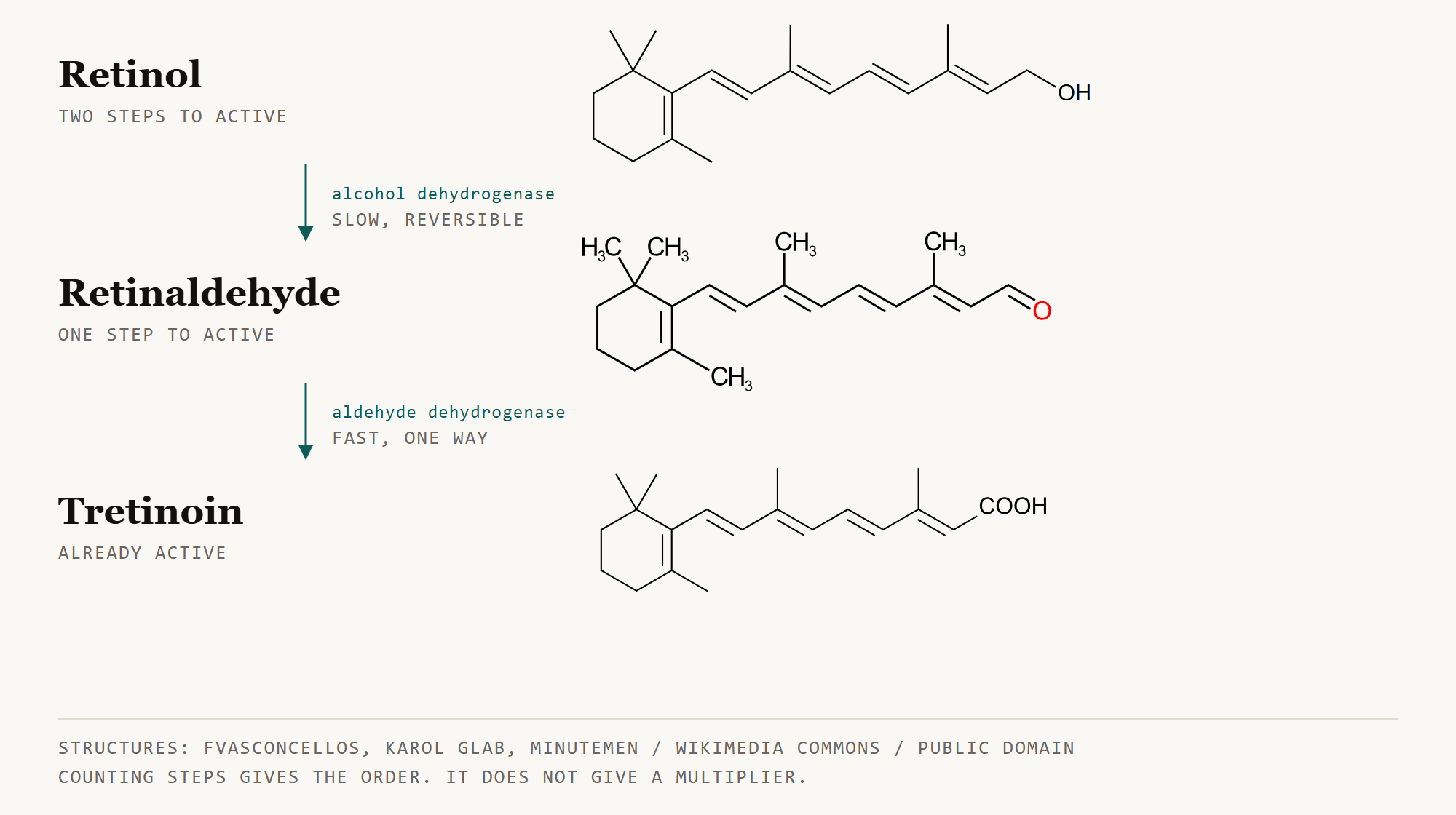
- Retinol needs two enzymatic steps. Alcohol dehydrogenase converts it to retinaldehyde, then an aldehyde dehydrogenase converts that to retinoic acid.
- Retinaldehyde needs one. It is already past the first gate.
- Tretinoin needs none. It is retinoic acid, applied directly, which is also why it is prescription only and why it stings.
Most explainers skip a detail that explains a lot. The first step, retinol to retinaldehyde, is the slow one, and it is reversible: skin can push retinaldehyde back to retinol as well as forward to retinoic acid. The second step, retinaldehyde to retinoic acid, is faster and runs one way. So the bottleneck sits at the start of retinol’s journey, which is a good mechanistic reason to expect retinol to underperform per unit and a poor reason to expect any particular multiplier.
Counting steps tells you the order. It does not tell you the ratio, because conversion efficiency is not a constant. It varies with how differentiated the cells are, what else is in the formula, the pH, and how much of the molecule survived the trip through the stratum corneum. The step count is biochemistry. The multiplier is a guess wearing biochemistry’s coat.
What about retinaldehyde?
Retinaldehyde sits between the two and has the best story of the three, which is why it needs the most care.
The order is supported. A 2021 split-face trial put retinaldehyde against retinol at matched percentages, 0.05% and 0.1%, on opposite sides of 23 faces for eight weeks, and the retinaldehyde side improved significantly more on every objective measure except dermal density. One caveat the trial itself is clear about: its retinaldehyde was delivered in multilamellar vesicles, so some of the advantage may belong to the delivery system rather than to the molecule. Older tolerability work from 1999, across 355 people over 44 weeks, found retinol and retinaldehyde had an equally low irritation potential while retinoic acid was markedly more irritating.
What does not exist, as far as we can find, is a trial that titrates retinaldehyde against retinol to locate an equivalence point. The 2021 study compared matched percentages, so it can say which is stronger at the same number on the label. It cannot say what percentage of retinol matches a given percentage of retinaldehyde, which is exactly what a conversion chart claims to know.
If you know of a study that titrates the two against each other, we would like to see it. We looked and came up empty, and an absence found by searching is weaker evidence than a paper found by reading.
The problem nobody mentions
Suppose every one of these numbers were solid. You still could not use them, because a good part of the retinol market does not tell you its percentage.
| Brand | Retinoid | Concentration on the label |
|---|---|---|
| The Ordinary | Retinol | Disclosed (0.2%, 0.5%, 1% lines) |
| Naturium | Retinaldehyde | Disclosed (0.05%, 0.10%, 0.15%) |
| Paula’s Choice | Retinol | Disclosed on some lines, not on others |
| Differin | Adapalene | Disclosed (0.1%, the FDA approved over the counter strength) |
| RoC | Retinol | Not disclosed. Described as a “milder strength of retinol” |
| Neutrogena | Retinol | Not disclosed. Described as an “accelerated retinol complex” |
Two of the largest and longest established retinol brands on the shelf treat the percentage as proprietary. You can hold a conversion chart in one hand and their product in the other and get nowhere, because the chart needs a number the label withholds. The asymmetry is worth noticing: the newer brands disclose concentration as a selling point, and the older ones rely on the brand name to carry it.
What to do instead
If the multipliers will not bear weight, the practical question is what will. Four things, in rough order of usefulness.
- Buy a disclosed concentration. Not because the number lets you compute an equivalence, but because it tells you what changed when you switch products. An undisclosed “retinol complex” cannot be measured, so you cannot tell whether a bad reaction came from the strength or the formula.
- Treat the order as reliable and the ratio as noise. Tretinoin acts more strongly than retinaldehyde, which acts more strongly than retinol, at the same number on the label. That much is well evidenced. Anything more precise is not.
- Let tolerance set the dose. The trials cited here run from eight to twenty four weeks, so the useful strength is the one you can keep using. A product that drives you off it in two weeks loses to a weaker one you tolerate for six months.
- Wear sunscreen. Unglamorous and not optional. Retinoids increase sensitivity to UV while you are using them, and photoaging is the thing you are treating.
Products that disclose what is in them
We are not going to tell you which of these is best, because we have not tested them and neither has anyone quoting a multiplier at you. What we can say is that each publishes its concentration, which is the one thing that makes an informed comparison possible. Links go to both the inexpensive and the expensive end, deliberately, so you can see the whole range rather than the end we happen to like.
- Retinol, at a concentration the trial actually tested: The Ordinary Retinol 0.5% in Squalane (paid link). Babcock paired 0.5% retinol against 0.05% tretinoin, so this sits on one of the rungs that study measured, in a vehicle simple enough that the retinol is doing the work.
- Retinaldehyde, in three disclosed steps: Naturium Retinaldehyde Cream Serum at 0.05%, 0.10% and 0.15% (paid links). Publishing a whole ladder is unusual for this ingredient, and it lets you move up a step deliberately rather than guessing at an equivalence.
- Adapalene: Differin Adapalene Gel 0.1% (paid link). The one prescription strength retinoid sold over the counter in the United States, and the only item here whose concentration was set by the FDA rather than by a brand.
You may notice there is no plain 1% retinol on that list. We went looking, because 1% against tretinoin 0.1% is the strongest pairing Babcock tested, and on Amazon the well known 1% products are sold in bundles rather than on their own. A small thing, but it is the same problem as the undisclosed percentages: the chart wants a number, and the shelf keeps not selling you one.
Frequently asked questions
There is no good evidence for that particular pairing. The one randomized split-face trial that tested a retinol to tretinoin ratio head to head used ten to one, pairing 1% retinol with 0.1% tretinoin, and found no significant difference between the two sides over twelve weeks. A 1% to 0.05% pairing implies a twenty to one ratio, which traces back to a review article rather than to a trial.
The ten times figure is back-calculated from a 1990 experiment measuring enzyme reaction rates in cultured cells, not from a clinical trial. Retinaldehyde does outperform retinol at the same labeled percentage in at least one split-face trial, so it is stronger. How much stronger has not been established by any study we could find.
Because a widely read 2006 review says it, and almost everyone downstream copied the review rather than its sources. The reference that review points to reports a tenfold difference in half-effect concentration, measured in cultured keratinocytes for a single enzyme endpoint, not a twentyfold clinical difference.
Not really, and that is a point in its favor. Adapalene is a synthetic retinoid rather than a converted form of vitamin A, so step counting does not apply to it. A 24 week trial in 86 women found adapalene 0.3% gel and tretinoin 0.05% cream produced no statistically significant difference across global photoaging, wrinkles and pigmentation.
No. Concentration is still the most useful number on the label, because it tells you what changed when you switch products and it lets you increase strength deliberately rather than by accident. What it does not support is converting between different retinoids using a fixed multiplier.
References
- Mukherjee, S., Date, A., Patravale, V., Korting, H.C., Roeder, A. and Weindl, G. (2006). Retinoids in the treatment of skin aging: an overview of clinical efficacy and safety. Clinical Interventions in Aging, 1(4), pp.327-348. Open access: PMC2699641.
- Kurlandsky, S.B., Xiao, J.H., Duell, E.A., Voorhees, J.J. and Fisher, G.J. (1994). Biological activity of all-trans retinol requires metabolic conversion to all-trans retinoic acid and is mediated through activation of nuclear retinoid receptors in human keratinocytes. Journal of Biological Chemistry, 269(52), pp.32821-32827. PMID 7806506.
- Siegenthaler, G., Saurat, J.H. and Ponec, M. (1990). Retinol and retinal metabolism. Relationship to the state of differentiation of cultured human keratinocytes. Biochemical Journal, 268(2), pp.371-378. Open access: PMC1131442.
- Babcock, J., Mehta, R., Makino, E.T. et al. (2015). A randomized, double-blind, split-face study comparing the efficacy and tolerability of three retinol-based products vs. three tretinoin-based products in subjects with moderate to severe facial photodamage. Journal of Drugs in Dermatology, 14(1), pp.24-30. PMID 25607905.
- Fluhr, J.W., Vienne, M.P., Lauze, C., Dupuy, P., Gehring, W. and Gloor, M. (1999). Tolerance profile of retinol, retinaldehyde and retinoic acid under maximized and long-term clinical conditions. Dermatology, 199(Suppl 1), pp.57-60. doi:10.1159/000051381.
- Bagatin, E., Gonçalves, H.S., Sato, M., Almeida, L.M.C. and Miot, H.A. (2018). Comparable efficacy of adapalene 0.3% gel and tretinoin 0.05% cream as treatment for cutaneous photoaging. European Journal of Dermatology, 28(3), pp.343-350. doi:10.1684/ejd.2018.3320.
- Kim, H. et al. (2021). The efficacy and safety of multilamellar vesicle containing retinaldehyde: a double-blinded, randomized, split-face controlled study. Journal of Cosmetic Dermatology. PMID 33569865.