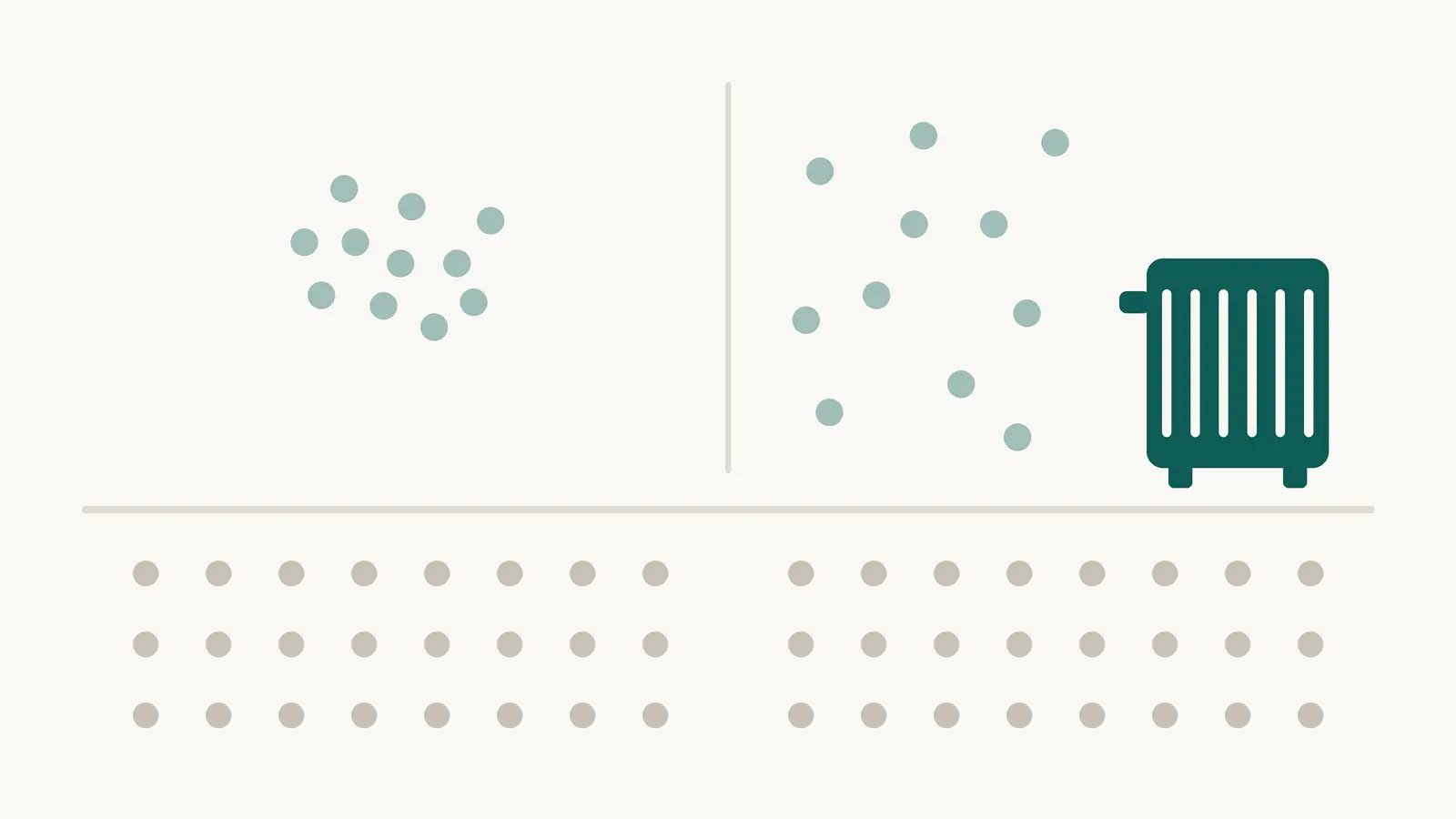
Every autumn the same advice comes round. The heating goes on, the indoor air dries out, dry indoor air pulls water out of your skin and weakens its barrier, so switch to a richer cream and buy a humidifier. It sounds like physics, and part of it is.
We took the advice apart and looked for the measurements under each claim. That heating dries the air holds up, and is easy to put a number on. That skin loses surface water within hours in dry air holds up too, in small studies. That dry air makes the barrier leak more water is where the evidence splits: short studies disagree, and the longest human exposure we found measured less water loss, not more. The humidifier question rests on one small field study and a review of symptom surveys.
Table of contents
- What the heating does to the air
- What dry air does to skin within hours
- What happens over weeks and seasons
- Why the barrier question is hard to measure
- What about humectants in dry air?
- What a moisturizer can do here
- Do humidifiers help your skin?
- The answer, case by case
- Verdict
- Where to find these
- References
We do not run a laboratory and we have tested nothing. Everything here comes from reading documents, all of them opened by us on 17 September 2026: nine studies and reviews read in full, the main sections of a Cochrane review, abstracts for the others, two public guidance documents, three brand pages, a university extension guide and a drug label.
Where we read only an abstract, we say so. Two measurement guidelines are paywalled and unread; we say where that limits us. None of this is medical advice. If you have eczema or another skin condition that flares in winter, the people to ask are a dermatologist or a pharmacist.
What the heating does to the air
Relative humidity, the percentage on a weather app or a hygrometer, is not a count of how much water is in the air. A University of Nebraska extension guide defines it as “a measure of how much moisture is present compared to how much moisture the air could hold at that temperature”. Warm air holds far more water than cold, so when cold outdoor air leaks into a house and is heated, the water in it stays the same and the percentage drops.
The size of the drop is arithmetic. Air at 0 degrees Celsius and 80% relative humidity, warmed to 20 degrees with nothing added, ends up at about 21%. That is our calculation, with the standard formula the New York study below uses. Real homes add water back from breathing, cooking, showers and drying laundry, so the figure on a hygrometer depends on the house.
Real buildings bear it out. A 2017 study put loggers in 34 New York City apartments through the winter of 2014 to 2015. They averaged 23.3 degrees Celsius and 6.7 millibars of water vapor pressure, and the authors conclude that “The wintertime indoor environment in this sample of New York City apartments is dry”. That is absolute humidity, not a percentage; converted with the paper’s own formula, the averages come to roughly 23% relative humidity over the winter and about 18% in February, approximate because an average of percentages would differ slightly.
About 23%
Relative humidity in 34 heated New York City apartments, winter 2014 to 2015, calculated by us from the average temperature and water vapor the study measured
Other buildings in other countries land in the same range. In a Finnish office study, rooms without humidification ran at 20.0 to 31.7%. A national survey of Swedish houses measured a mean of 34.2%, though the abstract does not say in which months. A larger New York study of 327 homes could not measure winter humidity at all: its sensors stopped reading at about 25%, and the authors call winter values “extremely low”. The US Environmental Protection Agency’s indoor air guide advises “Keep indoor humidity between 30 and 50 percent”.
What dry air does to skin within hours
Several small studies have put people in dry rooms and measured two things worth keeping apart. Hydration is how much water sits in the outer layer, read with a probe that responds to it electrically. Transepidermal water loss, TEWL for short, is how fast water evaporates out through the skin, read with a probe that senses the humidity just above it. The advice we started with is a claim about the second.
| Study | Hydration | Water loss |
|---|---|---|
| Sunwoo 2006, 16 men: two hours at 25 C and 10%, 30% or 50% | Fell on the face at 10% and 30%, then leveled off | Rose on the face at 10% and 30%, then leveled off; no humidity effect on the hand |
| Egawa 2002, Shiseido: 3 and 6 hours, level not in the abstract | Fell on forearm and cheek by 3 hours | Changed by 6 hours; the abstract suggests it fell |
| Tsukahara 2007, 20 people: 30 minutes at 40% after 30 at 70% | Fell on the eyelids | Not measured |
| Jang 2019, Amorepacific, 11 women: a night below 30%, another above 70% | Fell 24% after the dry night | No difference |
| Park 2023, 20 and 12 women: 6 hours at 25 C, under 20% | No change on the face; see below for the forearm | No change on the face; rose on the forearm |
The tidiest of these is the 2006 Japanese study by Sunwoo and colleagues, most of them at the Kyushu Institute of Design, because it held the temperature at 25 degrees and changed only the humidity. One author was at Kanebo Cosmetics, and an air-conditioning engineering firm, Techno Ryowa, part-funded it. Readings were taken in the dry room itself. On the face, hydration fell and water loss rose within half an hour at 10% and 30%, then both held steady for the rest of the two hours; at later readings the water loss “did not increase any further and was stabilized”. At 50%, the same humidity as the waiting room, water loss did not change. On the back of the hand, humidity made no difference to either.
The 2023 study from Korea needs care. It was run by staff of Celltem Pharm, a Seoul company, and it also tested a ceramide cream. Its results section reports a 1.11% change in hydration on the untreated forearm, yet its discussion says hydration there “decreased rapidly”. Its heated room was also warmer than the waiting room, 25 degrees against 20 to 24, and warmer skin loses water faster on its own; a six-woman chamber study that varied temperature and humidity separately found water loss tracked temperature, while humidity “had a weaker effect on TEWL”. On the face, where most people worry, it found no change in hydration or water loss.
Only one study we found went the other way. In 2023, researchers at Kyushu University raised a room at 25 degrees from 30% to 50% over 90 minutes and reported that water loss decreased; one author also works for Daikin, which makes air conditioning equipment. Abstract only.
So over hours the outer layer loses water in most studies that looked; water loss through the skin rose in some, not others, and where it rose in the Kyushu study it leveled off within half an hour.
What happens over weeks and seasons
Here the picture turns. The longest human exposure we found is a 2005 study of 49 men who worked 12-hour days in a manufacturing room kept at 1.5% relative humidity, drier than any home. Against 12 laboratory workers from a normal environment, their water loss was lower, not higher: “TEWL measurements showed a significant decline”, 8.3 against 10.0 in the study’s units. Their skin capacitance, a hydration reading, fell within two weeks and had almost completely recovered in the men who had worked there longest. The authors call this an alteration of the barrier, not an improvement, and lower is not the same as healthier: mice in dry air and people who had lived for years in the Arizona desert both grow a thicker outer layer, which is how the Arizona study read its lower water loss. We read the abstract only, one comparison group of 12 is small, and the study compared different men rather than following the same men. The same group’s three-year follow-up of 12 of these workers reported itching of the lower legs that developed into contact dermatitis diagnosed by a physician, and a Japanese survey of 12 people working in a room at 2.5% humidity found more skin symptoms than among 143 colleagues. Lower water loss did not mean untroubled skin.
8.3 vs 10.0
Water loss through the skin, in grams per square meter per hour, of 49 men working at 1.5% humidity against 12 men from a normal-humidity laboratory. Abstract only
Mouse studies point the same way, and suggest why the short and long answers can differ. In a 2002 study led from Shiseido’s research center, mice moved abruptly from very humid air to very dry air showed “a 6-7-fold increase in transepidermal water loss” that returned to normal within a week, but “No increase in transepidermal water loss occurred in response to a switch from a normal to a dry environment”. A 2002 study from Yonsei University kept mice in dry air for nine days and found “The baseline TEWL was not higher in the dry environment”. What the mice did show was faster cell turnover, a thicker outer layer and scaling, the part of the winter story these studies do support.
Seasonal studies of people are a tangle. A 2022 systematic review of studies since 2015 found that “Contradictory results were found on the effects of season and climate across the 11 studies, with no consensus reached”. Some found higher water loss in winter, such as a 2016 study of lower legs by Procter & Gamble scientists that also found fewer ceramides and other lipids in winter, and a small study in Sheffield that found water loss 22% lower by summer. Others found none, or found it higher in summer. The largest in the review, 2,005 people in Shanghai measured over eight years, found water loss higher when the outdoor air was drier. A 2013 study by Estée Lauder scientists reported that skin chronically exposed to a hot, dry climate showed “a lower baseline TEWL”.
Lower hydration in winter is the more consistent finding. A 2021 study of women in the Czech Republic, by scientists at Contipro, a Czech company, put it as “We confirmed a well-documented low SC hydration and sebum production in winter”, while finding winter water loss much the same as in summer and autumn. But winter is not only drier. It is colder and darker, with hotter showers and heavier clothes, and the review concludes that the effects “cannot be exclusively accounted for by temperature and relative humidity”.
Two reviews from 2016 are cited for the idea that dry air weakens the barrier, and they do not agree. One concludes that “low humidity and low temperatures lead to a general decrease in skin barrier function”. The other says human studies “demonstrated a reduction in transepidermal water loss” with low humidity, and that “there is some evidence that low humidity conditions can actually improve the barrier function of the skin”. We read only the abstracts, so we cannot say which studies each relied on.
Why the barrier question is hard to measure
These studies are hard to compare for a reason that also matters for any number printed on a moisturizer: both skin readings respond to the room they are taken in. A 2007 study that moved people from a room at 70% humidity to one at 40% for half an hour concluded that “even a 30% difference in RH can affect skin properties in 30 min”.
So measurement guidelines require a settling period in a controlled room. An international guideline from 2013, read in full, reports that the European EEMCO group recommends at least 15 to 30 minutes at 20 to 22 degrees Celsius and 40 to 60% relative humidity before measuring water loss, citing EEMCO’s 2001 guidance and a 1990 guideline by Pinnagoda and colleagues. Both sit behind paywalls, and the 1990 abstract gives no numbers. Four of the five seasonal studies the 2022 review describes measured skin after 20 to 30 minutes of rest in a room at 40% humidity or more; the fifth read people straight after 20 minutes outdoors in summer. They measured what lasts, not what skin is doing in a heated living room at 20%.
Brand claims seldom tell you this. First Aid Beauty advertises “2X immediate increase in skin hydration” from “an independent clinical study with 21 participants”. La Roche-Posay promises “72-hour dry skin relief” from a “28 day clinical study with 3-day relapse period”. CeraVe says its moisturizing cream was “clinically tested”. None of the three pages says what the product was compared against, at what temperature and humidity, or who ran the tests. That does not make the claims wrong. It means you cannot tell whether a result from a room at 50% would look the same in yours.
What about humectants in dry air?
The same advice often adds that humectants such as hyaluronic acid and glycerin turn against you in dry air, pulling water out of skin instead of in. Our article on hyaluronic acid in dry air followed that claim to the oldest tests we could read: for glycerin, forearms under drying conditions in the 1950s and a laboratory dish in 1974, contradicted at ordinary room humidity in 1988; for hyaluronic acid on its own, on living skin in dry air, nothing. Nothing in this article settles it either.
What a moisturizer can do here
If the dependable change in dry air is water leaving the outer layer, the obvious response is to slow it down. Few studies have tested that. In the 2023 Korean study, a cream containing ceramides, ectoin and glycerin kept forearm water loss from rising over six hours in air under 20%, and raised hydration, against the untreated site; all four authors work for Celltem Pharm, which ran the study, and the cream is not named. In a 1998 study on mice, a plastic film, petrolatum and a humectant each prevented the changes dry air caused: “All three forms of treatment prevented the epidermal hyperplasia and dermal mast cell hypertrophy and degranulation induced by exposure to low humidity”.
Petrolatum is one of the few ingredients whose strength a label has to state, because in the US it can be sold as a skin protectant drug. Vaseline Healing Jelly declares “WHITE PETROLATUM, USP (100%)”, and among its listed uses “helps protect from the drying effects of wind and cold weather”. Our mineral oil article covers what occlusives do, and how little has been measured about how well. A cosmetic cream lists no strengths; our guide to ingredient lists explains what their order can and cannot tell you.
Do humidifiers help your skin?
This is where the evidence is thinnest. A 2021 Cochrane review of humidification at work and in schools found that indoor air humidification “may have little and non‐significant effect on dryness skin symptoms”. That rests on two pooled studies rated low certainty, and a second pair of before-and-after studies rated very low. Its authors call for future trials “assessing dryness symptoms more technically”. The one instrumented field study we could read is a 2022 study in Edinburgh, also listed in the 2022 review: 11 students and 11 care home residents had domestic humidifiers run in their rooms, raising average humidity from 35% to about 50% in the student rooms and from 31% to about 42% in the care home, with forearm readings in each period. Water loss showed no relation to room humidity; surface hydration tracked the water in the air, weakly. The authors cite an earlier care home study of their own that did find water loss correlated with room humidity; we could not read it.
There is also a question of whether a humidifier changes the air much. In the New York apartment study, “Ownership of a humidifier was not associated with higher indoor humidity levels”. Across those 34 homes, rooms with one were under a percentage point more humid by our conversion, and the study did not record whether they were ever switched on. In Edinburgh they were, and the rooms rose by 5 to 15 points. What one would do in your house is a job for a hygrometer.
If you run one, the EPA’s fact sheet on home humidifiers is specific: “Clean portable humidifiers every third day”, use low-mineral water such as distilled, and “Do not humidify to indoor relative humidity levels exceeding 50 percent”. Ultrasonic and impeller models, the cool mist kind, can spread minerals and microorganisms from their tanks, while “Steam vaporizer and evaporative humidifiers are not expected to disperse substantial amounts of minerals”. For the cool mist kind it names distilled water first, since “Distillation is the most effective method for removing minerals from water”; deionized water removes most minerals but on average leaves more behind; and of demineralization cartridges and filters it says “the ability of these devices to remove minerals may vary widely”, so white dust on nearby surfaces is the sign they are not keeping up. A humidifier is an appliance, not a skin treatment, and we make no skin claim for one.
The answer, case by case
| Question | What we found | What kind of evidence |
|---|---|---|
| Does heating dry the air? | Yes. Heated homes and offices measured around 18 to 34% | Physics, and loggers in real buildings |
| Does skin lose surface water in dry air? | Yes, within hours, in most studies that looked | Small chamber studies, several run by cosmetics companies |
| Does dry air raise water loss through skin? | Sometimes, briefly. Not in the longest human exposure we found, where it was lower | Small chamber studies; one study of workers, abstract only; mice |
| Is skin different in winter? | Usually less hydrated. Water loss results conflict | Seasonal studies that cannot separate humidity from the rest of winter |
| Does a humidifier help skin? | Not shown. Self-reported dryness changed little; in one field study water loss did not track room humidity | One Cochrane review of workplace studies; one field study of 22 people |
| Does a moisturizer help in dry air? | In the one human test we found, a ceramide cream kept water loss from rising for six hours | One company study; one mouse study |
Verdict
Verdict
The heating dries the air for certain. What it does to your skin barrier is not settled
Heated rooms in winter can sit around 20% relative humidity, and within hours of dry air the outer layer of skin holds less water. That part of the advice has measurements behind it. The claim that dry air makes the barrier leak more water does not hold as a general rule: short studies disagree, seasonal studies conflict, and the longest human exposure we found, men working at 1.5% humidity, measured less water loss rather than more, and less is not the same as better. In the one field study we could read that measured skin with instruments while humidifiers ran, in 22 people, water loss showed no relation to room humidity.
- Heated rooms: often near 20% humidity.
- Surface hydration: drops within hours.
- Barrier water loss: not settled.
- Months in very dry air: lower, in one study.
- Humidifiers and skin: one small field study.
Where to find these
The links below are affiliate links, and the disclosure above the article applies to all four. The first is a ceramide cream sold as a cosmetic, not the unnamed cream in the Korean study. The second is a petrolatum jelly sold as an over-the-counter skin protectant. The third is an ultrasonic cool mist humidifier with a built-in humidity sensor, the type the EPA advises running on distilled water and cleaning every third day; no study above tested it, and we make no claim for it about skin. The fourth is the scale-inhibitor cartridge DREO sells for that model, which its listing says reduces calcium and magnesium in the tank water; we found no measurement of how well it works, and the EPA’s caution above about such devices applies. None of them has been tested by us.
- CeraVe Moisturizing Cream (paid link)
- Vaseline Original Healing Jelly (paid link)
- DREO 747S Smart Humidifier (paid link)
- DREO Scale-Inhibitor Cartridge for the 747S (paid link)
Heating lowers the relative humidity of indoor air; heated homes can fall to around 20 percent. In small studies, the outer layer of skin held less water after a few hours in dry air. Whether that damages the barrier over a whole winter has not been shown.
Sometimes, briefly. In a 2006 study, water loss from the face rose within 30 minutes at 10 and 30 percent humidity and then leveled off. In a 2005 study of workers spending 12 hours a day at 1.5 percent humidity, water loss was lower than in a comparison group, and studies of winter skin disagree.
No study we found has set a humidity level that is best for skin. The US Environmental Protection Agency advises keeping homes between 30 and 50 percent and not humidifying above 50 percent, because higher humidity can encourage mold and dust mites.
Not shown. A 2021 Cochrane review of workplace humidification found little and non-significant effect on reported skin dryness, at low certainty. In the one instrumented field study we found, 22 people in Edinburgh whose rooms were humidified to 40 and 50 percent, water loss did not track room humidity and surface hydration tracked it only weakly.
What holds up is that skin surface water drops in dry air and that covering skin slows water leaving it. In one company study a ceramide cream kept forearm water loss from rising over six hours in very dry air. We found no study comparing lighter and richer creams in winter.
References
- Shelton DP. Air Properties: Temperature and Relative Humidity. NebGuide G1849, University of Nebraska-Lincoln Extension, 2008. PDF. Read in full.
- Quinn A, Shaman J. Indoor temperature and humidity in New York City apartments during winter. Science of the Total Environment 2017;583:29-35. PMC. Read in full. Supported by US National Institutes of Health grants.
- Tamerius JD, Perzanowski MS, Acosta LM, et al. Socioeconomic and Outdoor Meteorological Determinants of Indoor Temperature and Humidity in New York City Dwellings. Weather, Climate, and Society 2013;5(2):168-179. PMC. Read in full.
- Reinikainen LM, Jaakkola JJ. Significance of humidity and temperature on skin and upper airway symptoms. Indoor Air 2003;13(4):344-352. Europe PMC. Abstract read.
- Wang J, Norbäck D. Subjective indoor air quality and thermal comfort among adults in relation to inspected and measured indoor environment factors in single-family houses in Sweden: the BETSI study. Science of the Total Environment 2022;802:149804. Europe PMC. Abstract read.
- US Environmental Protection Agency. Care for Your Air: A Guide to Indoor Air Quality and Use and Care of Home Humidifiers (EPA 402-F-22-002, 2022). Read in full.
- Sunwoo Y, Chou C, Takeshita J, Murakami M, Tochihara Y. Physiological and subjective responses to low relative humidity. Journal of Physiological Anthropology 2006;25(1):7-14. J-STAGE. Read in full. One author at Kanebo Cosmetics; funded in part by Techno Ryowa Ltd.
- Egawa M, Oguri M, Kuwahara T, Takahashi M. Effect of exposure of human skin to a dry environment. Skin Research and Technology 2002;8(4):212-218. Europe PMC. Abstract read.
- Tsukahara K, Hotta M, Fujimura T, Haketa K, Kitahara T. Effect of room humidity on the formation of fine wrinkles in the facial skin of Japanese. Skin Research and Technology 2007;13(2):184-188. Europe PMC. Abstract read.
- Jang SI, Han J, Lee M, Seo J, Kim BJ, Kim E. A study of skin characteristics according to humidity during sleep. Skin Research and Technology 2019;25(4):456-460. Europe PMC. Abstract read.
- Park EH, Jo DJ, Jeon HW, Na SJ. Effects of winter indoor environment on the skin: Unveiling skin condition changes in Korea. Skin Research and Technology 2023;29(6):e13397. PMC. Read in full. Authors from Celltem Pharm; no funding statement.
- Hashiguchi N, Tochihara Y, Takeda A, Yasuyama Y. Effects of indoor summer dehumidification and winter humidification on the physiological and subjective responses of the elderly. Journal of Thermal Biology 2023;111:103390. Europe PMC. Abstract read.
- Chou TC, Lin KH, Wang SM, et al. Transepidermal water loss and skin capacitance alterations among workers in an ultra-low humidity environment. Archives of Dermatological Research 2005;296(10):489-495. Europe PMC. Abstract read.
- Chou TC, Lin KH, Sheu HM, et al. Alterations in health examination items and skin symptoms from exposure to ultra-low humidity. International Archives of Occupational and Environmental Health 2007;80(4):290-297. Europe PMC. Abstract read.
- Sato M, Fukayo S, Yano E. Adverse environmental health effects of ultra-low relative humidity indoor air. Journal of Occupational Health 2003;45(2):133-136. Europe PMC. Abstract read.
- Cravello B, Ferri A. Relationships between skin properties and environmental parameters. Skin Research and Technology 2008;14(2):180-186. Europe PMC. Abstract read.
- Liu X, Gao Y, Zhang Y, Wang X. Variation in skin biology to climate in Shanghai, China. Cutaneous and Ocular Toxicology 2017;36(3):231-236. Europe PMC. Abstract read.
- Sato J, Denda M, Chang S, Elias PM, Feingold KR. Abrupt decreases in environmental humidity induce abnormalities in permeability barrier homeostasis. Journal of Investigative Dermatology 2002;119(4):900-904. Europe PMC. Abstract read.
- Choi EH, Kim MJ, Ahn SK, et al. The skin barrier state of aged hairless mice in a dry environment. British Journal of Dermatology 2002;147(2):244-249. Europe PMC. Abstract read.
- Denda M, Sato J, Tsuchiya T, Elias PM, Feingold KR. Low humidity stimulates epidermal DNA synthesis and amplifies the hyperproliferative response to barrier disruption. Journal of Investigative Dermatology 1998;111(5):873-878. Europe PMC. Abstract read.
- Green M, Kashetsky N, Feschuk A, Maibach HI. Transepidermal water loss (TEWL): Environment and pollution. A systematic review. Skin Health and Disease 2022;2(2):e104. PMC. Read in full.
- Dolečková I, Čápová A, Machková L, et al. Seasonal variations in the skin parameters of Caucasian women from Central Europe. Skin Research and Technology 2021;27(3):358-369. Europe PMC. Abstract read.
- Wei KS, Stella C, Wehmeyer KR, et al. Effects of season stratum corneum barrier function and skin biomarkers. Journal of Cosmetic Science 2016;67(3):185-203. SCC library. Read in full. All but one author at Procter & Gamble.
- Uchegbulam I, Danby SG, Lewis R, Carré MJ, Maiti R. Effect of seasonal change on the biomechanical and physical properties of the human skin. Journal of the Mechanical Behavior of Biomedical Materials 2022;127:105058. Europe PMC. Abstract read.
- Muizzuddin N, Ingrassia M, Marenus KD, Maes DH, Mammone T. Effect of seasonal and geographical differences on skin and effect of treatment with an osmoprotectant: Sorbitol. Journal of Cosmetic Science 2013;64(3):165-174. SCC library. Read in full. Authors at Estée Lauder; 18 women in Tucson against 22 on Long Island.
- Engebretsen KA, Johansen JD, Kezic S, Linneberg A, Thyssen JP. The effect of environmental humidity and temperature on skin barrier function and dermatitis. Journal of the European Academy of Dermatology and Venereology 2016;30(2):223-249. Europe PMC. Abstract read.
- Goad N, Gawkrodger DJ. Ambient humidity and the skin: the impact of air humidity in healthy and diseased states. Journal of the European Academy of Dermatology and Venereology 2016;30(8):1285-1294. Europe PMC. Abstract read.
- du Plessis J, Stefaniak A, Eloff F, et al. International guidelines for the in vivo assessment of skin properties in non-clinical settings: Part 2. transepidermal water loss and skin hydration. Skin Research and Technology 2013;19(3):265-278. PMC. Read in full.
- Pinnagoda J, Tupker RA, Agner T, Serup J. Guidelines for transepidermal water loss (TEWL) measurement. Contact Dermatitis 1990;22(3):164-178. Wiley. Abstract read; paywalled, full text not read.
- Rogiers V; EEMCO Group. EEMCO guidance for the assessment of transepidermal water loss in cosmetic sciences. Skin Pharmacology and Applied Skin Physiology 2001;14(2):117-128. Europe PMC. Abstract read; paywalled, full text not read.
- Byber K, Radtke T, Norbäck D, et al. Humidification of indoor air for preventing or reducing dryness symptoms or upper respiratory infections in educational settings and at the workplace. Cochrane Database of Systematic Reviews 2021;12:CD012219. PMC. Summary, conclusions and summary of findings read.
- Jin Y, Wang F, Payne SR, Weller RB. A comparison of the effect of indoor thermal and humidity condition on young and older adults’ comfort and skin condition in winter. Indoor and Built Environment 2022;31(3):759-776. Sage. Read in full. Funded by a Heriot-Watt University PhD project.
- Drug Facts label on DailyMed for Vaseline Healing Jelly. Read in full.
- Brand pages read 17 September 2026: First Aid Beauty Ultra Repair Cream Intense Hydration, La Roche-Posay Lipikar AP+MAX Triple Repair Moisturizing Cream, CeraVe Moisturizing Cream.