In March 2026 a systematic review in Frontiers in Medicine pooled 19 randomized trials of peptides for skin aging and put its conclusion in a box at the top of the paper: oral peptides “significantly improve skin hydration” and wrinkles, “outperforming topical formulations.” Nearly every brand in this market sells the cream, so that is a striking sentence, and it is already doing the rounds as the answer to whether you should swallow your collagen or rub it on.
We read the paper, its tables and the trials underneath it. The short version: the sentence in the box is not quite what the paper found. Its numbers do not match the paper’s own results tables. The comparison with creams rests on two small topical trials. And at least one of the collagen studies it pools appears to be a trial the European Food Safety Authority reviewed in 2013, concluding the effect had not been established. None of that makes collagen useless. It does make “pills beat creams” a claim rather than a finding.
Table of contents
- What the 2026 meta-analysis says
- The headline numbers are not the paper’s numbers
- Seventeen trials against two
- What 5.80 is measured in
- Who paid for the trials
- Can peptides get through skin at all?
- Does swallowed collagen reach your skin?
- So which should you buy?
- Products that disclose what is in them
- Frequently asked questions
- References
We do not run a laboratory and we have not tested any product in this article. What we did was read the review in full, pull the primary records for the trials it leans on, and check the regulatory decisions that touch them. Every source is listed at the bottom, so you can check the same pages we did.
What the 2026 meta-analysis says
The paper is Nukaly and colleagues, “Oral and topical peptides for skin aging”, published on 17 March 2026 and free to read. It pools 19 randomized controlled trials, 1,341 people in all, and asks whether peptides, swallowed or applied to the skin, improve hydration, wrinkles, elasticity and a handful of other measures compared with a placebo.
A meta-analysis is only as good as two things: whether the trials it pools measure the same thing, and whether those trials can be trusted. People quote the headline. The tables tell you whether it holds.
The headline numbers are not the paper’s numbers
The Highlights box gives two figures for oral polypeptides: a mean difference of 5.80 for hydration (p < 0.01) and 0.35 for wrinkle reduction (p = 0.05). Here is what the rest of the same paper reports.
| Measure | Highlights box | Abstract, Results and tables |
|---|---|---|
| Wrinkles, all peptides | not given | 0.27 (95% CI 0.01 to 0.52), p = 0.04 |
| Wrinkles, oral polypeptides | 0.35, p = 0.05 | 1.5, p = 0.01 |
| Hydration | 5.80, credited to oral polypeptides | 5.79 in Table 4, the pooled figure for all peptides |
The hydration number is 5.79 rounded, but the paper labels it three ways: as the pooled result for all peptides in Table 4, as the result for oral polypeptides in the Highlights, and as the result for oral tripeptides in one Results sentence, while another sentence gives oral tripeptides 16.50. The wrinkle gap is plainer. A figure of 0.35 at p = 0.05 appears nowhere else in the paper, and the subgroup figure the Results section reports is roughly four times larger. We are not suggesting anything sinister; Highlights boxes are often written last and edited separately. But the two numbers now circulating as the paper’s findings are the one part of the paper that disagrees with the rest of it.
Verdict
“Outperforming topical formulations” is a sentence on the front page, not a result in the tables
The review does report larger effects for oral products. What it cannot do, by its own account, is compare them fairly with creams. The next section explains why.
Seventeen trials against two
17 trials
Oral peptides and collagen
1,236 participants. Mostly collagen hydrolysates from fish or pig skin, plus one cartilage product and one glucosamine tablet.
2 trials
Topical peptides
105 participants. One Argireline cream around the eyes, one cream built on defensin peptides. Neither is a collagen product.
Pills against creams here means 17 oral studies against 2 topical ones. The authors say as much in their discussion: the imbalance “restricts the ability to directly compare their relative efficacy.” It is an honest limitation. It also sits a long way below the sentence saying oral products outperformed topical ones.
Nor is the oral side uniform. The review’s own table of included studies lists one trial of “N-acetyl D-glucosamine and glucosamine sulfate”, which is not a peptide, and one of type II collagen from chicken cartilage with chondroitin, a product usually sold for joints. Both are pooled with the fish and pork collagen trials under the same heading.
We also looked for a trial that gave one group a collagen supplement, another a peptide cream, and measured both. We could not find one. Every oral-versus-topical comparison you will read, this review’s included, is made across separate studies with different people, products and instruments.
What 5.80 is measured in
A mean difference is the gap between the treated group and the placebo group, in whatever unit the trial used. So the unit matters. A difference of 5.80 in skin-moisture meter units, 5.80 percentage points and 5.80 cubic millimeters of wrinkle volume are three different claims.
The trials in this review do not share one. From the paper’s own table of included studies: wrinkle volume in cubic millimeters from a 3D optical scanner, a 0 to 4 wrinkle grading scale where a higher score is worse, counts of visible wrinkles from facial imaging, and the percentage of participants whose wrinkles were rated as improved. The authors write that “the methodologies used to obtain these measurements were not consistently described” in many trials.
When trials measure the same outcome on different scales, a meta-analysis normally converts each result to a standardized effect size before pooling. This review reports plain mean differences throughout, and the phrase “standardized mean difference” does not appear in it. The pooled numbers are therefore averages of quantities in different units, which is why we would not lean on their exact size, in either direction.
84% to 99%
Heterogeneity (I²) for the pooled hydration, elasticity, roughness, brightness, texture and density results in Table 4. Values this high mean the trials disagree with one another far more than chance alone would explain.
Who paid for the trials
The review grades randomization, blinding and dropouts with a standard risk-of-bias tool. It does not report who funded the trials it includes, and it does not test for publication bias, the tendency for positive trials to reach print while negative ones stay in a drawer. In a category where many trials use a branded ingredient, both omissions matter.
Two of the included studies are by Proksch and colleagues, both from 2014, both trials of VeriSol, a branded collagen peptide. The first, 114 women aged 45 to 65 taking 2.5 g a day for eight weeks, reported a 20% reduction in eye wrinkle volume against placebo. The second, 69 women aged 35 to 55 on 2.5 g or 5 g a day, reported better skin elasticity. On skin moisture, its own abstract says a positive influence was seen “in a subgroup analysis, but data failed to reach a level of statistical significance.”
In 2013 the European Food Safety Authority assessed a health claim for VeriSol, on an application from its maker, Gelita AG. The evidence included an unpublished trial of 69 women aged 35 to 55 on 2.5 g, 5 g or placebo for eight weeks, which matches the second Proksch study in every detail we can check. EFSA’s summary of that trial: “There were no significant differences between the groups for transepidermal water loss or skin hydration at any time point.” Its overall conclusion was that “a cause and effect relationship has not been established”, and the claim was refused.
Collagen supplement advertising has met a similar reception in the UK. In 2023 the Advertising Standards Authority upheld a complaint against Kollo Health and told the company not to claim its collagen product could “maintain the elasticity and firmness of the skin, reduce the appearance of fine lines and wrinkles” without robust evidence.
The cream side is no more independent. Neither of the two trials below is in the review; they test Matrixyl and copper peptide, two peptides sold in serums. The best-known trial of the peptide sold as Matrixyl, 93 women over 12 weeks, found a significant improvement in fine lines against a plain moisturizer. The paper lists Procter & Gamble, which sells peptide creams, as its authors’ affiliation. The one trial we found with no apparent industry link, a copper peptide study after laser resurfacing, found no objective difference in wrinkles or skin quality, though only 13 patients completed it.
Can peptides get through skin at all?
The usual argument against peptide creams is size. The outer layer of skin exists to keep large molecules out, and peptides are large. The number attached to that argument is 500 daltons, and it deserves the same scrutiny as any other number.
It comes from a short paper by Bos and Meinardi in 2000. Their words are “We argue that the molecular weight (MW) of a compound must be under 500 Dalton to allow skin absorption”, and the argument rests on three observations: common contact allergens, standard topical drugs and transdermal patch drugs all sit under 500. That is a reasoned rule of thumb drawn from a pattern among approved drugs and allergens, not a measurement of where penetration stops.
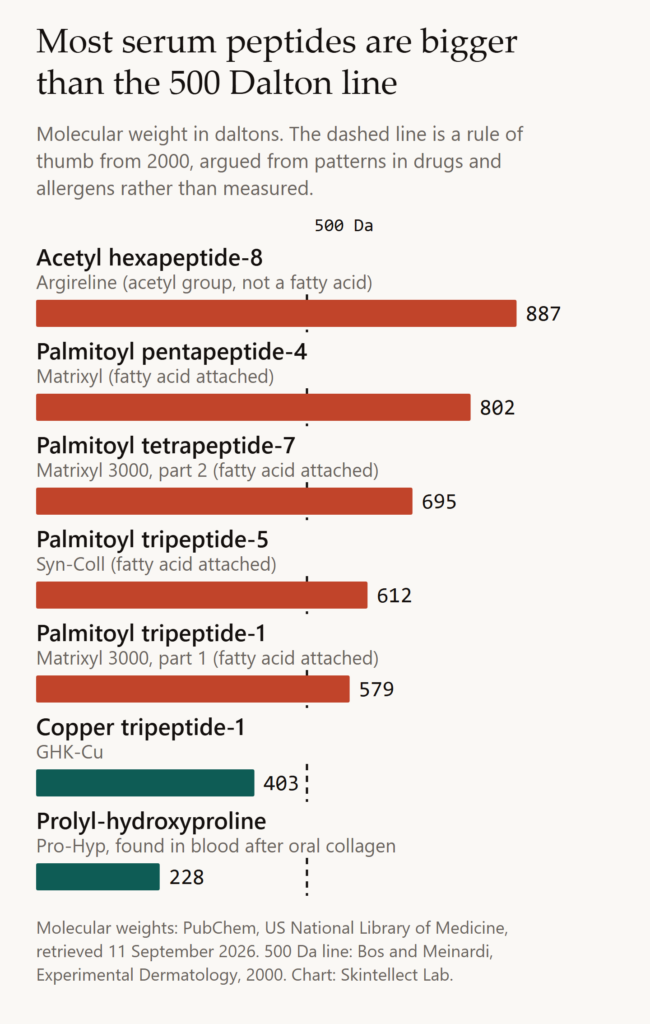
With that caveat, the chart still tells you something. Most of the peptides sold in serums sit well above the line, and four of them carry a fatty acid chain (the “palmitoyl” in the name), bolted on because their makers expected them to struggle to get in. Copper peptide is the clear exception at about 403. The small fragment that turns up in the blood after swallowing collagen, prolyl-hydroxyproline, is 228.
Does swallowed collagen reach your skin?
Partly established. A Japanese pilot study, funded by a government research grant, gave five women 5 g of collagen hydrolysate and found collagen-derived fragments, including prolyl-hydroxyproline, in their blood for several hours afterward. The same paper showed one of those fragments speeding the growth of mouse skin cells in a dish.
That is evidence that something from the supplement gets into the bloodstream. It is not a measurement of anything arriving in human skin. We looked for a study that took skin samples from people after they swallowed collagen and measured the fragments there, and could not find one. The closest is a 2017 study that measured collagen fragments, including prolyl-hydroxyproline, in human blood and, in mice, in the skin itself. That makes the route plausible, but mouse skin is not human skin.
So which should you buy?
Neither has evidence strong enough to settle it. Oral collagen has more trials behind it, and they lean positive, but the pooled effects are of uncertain size, measured on mismatched scales, and drawn heavily from branded ingredients that have not persuaded the regulators and advertising watchdogs who looked at them. Topical peptides have fewer trials, the best-known of them from a company that sells peptide creams, and one small independent trial, in skin healing after laser treatment, that found no objective difference.
If you want to try oral collagen, the most defensible choice on the evidence is a product that names its collagen ingredient and dose on the label, so you can match it to a trial. The VeriSol studies ran for eight weeks at 2.5 g a day, with a 5 g group in the second, and the trials in this review ran for 4 to 12 weeks, so judging a supplement after two weeks tells you nothing.
If you want a peptide serum, buy it as a moisturizer you would use anyway, with the peptides as an unproven extra rather than the reason. Read the ingredient list. Peptides are expensive and usually present in tiny amounts, and a serum that lists seven of them rarely says how much of each is in the bottle.
One last point, on regulation. The US Food and Drug Administration’s own guidance says a product intended to make wrinkles less noticeable “simply by moisturizing the skin” is a cosmetic, while one intended “to remove wrinkles or increase the skin’s production of collagen” is a drug. A cream that promises to boost your collagen is, on the FDA’s wording, making a drug claim.
Where this leaves you
More trials behind the pills, weak evidence behind both
If you take a collagen supplement, choose one that discloses its dose and give it at least eight weeks. If you use a peptide serum, choose it for the formula as a whole. Do not pay extra for either on the strength of “pills beat creams”.
Products that disclose what is in them
We have not tested these and are not ranking them. Each is here because it states its key ingredients clearly enough to check against the evidence above. Both collagen listings make claims for their products that go further than that evidence; we are pointing at their labels, not their marketing.
- Oral collagen that names its ingredient and dose: Great Lakes Wellness Advanced Collagen Peptides (paid link). Its supplement facts list VERISOL collagen peptides at 2.5 g per serving, the ingredient and daily dose of both Proksch trials, alongside 9.5 g of other bovine collagen peptides, hyaluronic acid, biotin and vitamin C.
- Oral collagen, a second option: Sparkle Wellness VERISOL Collagen Peptides (paid link). Its listing states 2,500 mg of VERISOL peptides per serving, the same 2.5 g, with vitamin C.
- A multi-peptide serum with a published ingredient list: The Ordinary Multi-Peptide + HA Serum (paid link). Its listed ingredients include seven peptides, with acetyl hexapeptide-8 fourth after water, glycerin and a ferment lysate. It does not state their concentrations.
The peptides on that serum’s label, in the order listed:
- Acetyl hexapeptide-8
- Pentapeptide-18
- Palmitoyl tripeptide-1
- Palmitoyl tetrapeptide-7
- Palmitoyl tripeptide-38
- Dipeptide diaminobutyroyl benzylamide diacetate
- Acetylarginyltryptophyl diphenylglycine
Frequently asked questions
Possibly, modestly. Most randomized trials report some improvement in hydration, elasticity or wrinkles against placebo, but the effects are measured on different scales, many trials test a branded ingredient, and the European Food Safety Authority refused a skin claim for one of the best-known products in 2013 because a cause and effect relationship had not been established.
The evidence is thin. There are a handful of trials, most run or authored by companies that sell the peptide, and the one independent trial we found, a small study after laser resurfacing, found no objective difference in wrinkles or skin quality.
Many of them are above the 500 dalton rule of thumb, which is a pattern observed in drugs and allergens rather than a measured limit. Copper peptide is below it. Makers attach fatty acid chains to several peptides to help them penetrate, but how much reaches the living layers of skin from a typical serum is not well documented.
Not in the same people, as far as we could find. The 2026 review compares 17 oral trials with 2 topical trials run separately, and its authors say that imbalance restricts any direct comparison.
The trials in the 2026 review ran for 4 to 12 weeks, and the VeriSol studies ran for eight weeks at 2.5 g a day, with a 5 g group in the second. Anything shorter than that is not a fair test.
References
- Nukaly, H.Y. et al. (2026). Oral and topical peptides for skin aging: a systematic review and meta-analysis of randomized controlled trials. Frontiers in Medicine, 13, 1618306. Open access: 10.3389/fmed.2026.1618306.
- Proksch, E., Schunck, M., Zague, V., Segger, D., Degwert, J. and Oesser, S. (2014). Oral intake of specific bioactive collagen peptides reduces skin wrinkles and increases dermal matrix synthesis. Skin Pharmacology and Physiology, 27(3), pp.113-119. PMID 24401291.
- Proksch, E., Segger, D., Degwert, J., Schunck, M., Zague, V. and Oesser, S. (2014). Oral supplementation of specific collagen peptides has beneficial effects on human skin physiology: a double-blind, placebo-controlled study. Skin Pharmacology and Physiology, 27(1), pp.47-55. PMID 23949208.
- EFSA Panel on Dietetic Products, Nutrition and Allergies (2013). Scientific Opinion on the substantiation of a health claim related to VeriSol®P and a change in skin elasticity leading to an improvement in skin function. EFSA Journal, 11(6), 3257. 10.2903/j.efsa.2013.3257.
- Advertising Standards Authority (2023). Ruling on Kollo Health Ltd, A23-1196136. asa.org.uk.
- Robinson, L.R., Fitzgerald, N.C., Doughty, D.G., Dawes, N.C., Berge, C.A. and Bissett, D.L. (2005). Topical palmitoyl pentapeptide provides improvement in photoaged human facial skin. International Journal of Cosmetic Science, 27(3), pp.155-160. PMID 18492182.
- Miller, T.R., Wagner, J.D., Baack, B.R. and Eisbach, K.J. (2006). Effects of topical copper tripeptide complex on CO2 laser-resurfaced skin. Archives of Facial Plastic Surgery, 8(4), pp.252-259. PMID 16847171.
- Bos, J.D. and Meinardi, M.M. (2000). The 500 Dalton rule for the skin penetration of chemical compounds and drugs. Experimental Dermatology, 9(3), pp.165-169. PMID 10839713.
- Shigemura, Y., Iwasaki, Y., Tateno, M., Suzuki, A., Kurokawa, M., Sato, Y. and Sato, K. (2018). A pilot study for the detection of cyclic prolyl-hydroxyproline (Pro-Hyp) in human blood after ingestion of collagen hydrolysate. Nutrients, 10(10), 1356. 10.3390/nu10101356. PMID 30248982.
- Yazaki, M. et al. (2017). Oral ingestion of collagen hydrolysate leads to the transportation of highly concentrated Gly-Pro-Hyp and its hydrolyzed form of Pro-Hyp into the bloodstream and skin. Journal of Agricultural and Food Chemistry, 65, pp.2315-2322. PMID 28244315.
- US Food and Drug Administration. Wrinkle Treatments and Other Anti-aging Products. fda.gov.
- PubChem, US National Library of Medicine. Molecular weights for the peptides charted above, retrieved 11 September 2026. pubchem.ncbi.nlm.nih.gov.